
How to Open a Co-working Space in Malaysia

The pandemic changed how we work, and honestly, a lot of us don't want to go back.
Companies realised they were paying a fortune for office space their employees resented commuting to. Employees realised they could get just as much done — sometimes more — without the commute, the parking, and the fluorescent lighting.
Demand for flexible workspace in Malaysia is growing. And on paper, the co-working business model looks attractive: collect rent upfront, no long payment terms, scalable, brand-driven.
The problem is that most co-working spaces lose money.
As Tim Tiah, co-founder of Colony — one of Malaysia's most recognisable co-working brands — put it: he visited co-working spaces in Singapore that were 90% full and assumed they were printing money. Two years later he pulled their accounts and discovered that every single one was losing money. Watch the whole podcast here.
A co-working space is a capital-intensive, operationally demanding business. Here's how to do it properly.
Step 1: Decide who you're serving — and build everything around that model
Before you design anything, before you look at a single location, decide who you want walking through your doors every day.
Because everything else — your layout, your pricing, your membership plans, even how you decorate the place — flows from that one decision.
Freelancers and solopreneurs want flexibility. They need a clean, professional space with good wifi that isn't a café. Serve this segment and your space is mostly hot desks, day passes, and monthly flexible plans. Price sensitivity is real — they compare you directly against their kitchen table and the nearest Starbucks.
Small teams and SMEs need something more permanent. A dedicated desk or small private office, a meeting room they can book, and a proper business address. They sign longer commitments, pay more, and churn less. This segment needs more enclosed spaces and fewer open hot desk areas.
Corporates pay the highest rates and sign the longest contracts. Post-COVID, companies trying to entice staff back started taking entire floors of premium co-working spaces instead of signing traditional office leases. If you want this segment, your space needs to look and feel like somewhere a professional would be proud to bring a client.
Your customer decision also determines your business model. A freelancer-heavy space runs lean and automated — minimal staff, self-service access, suburban locations where rent is lower.
A corporate-facing space needs hospitality, design, and a premium address — higher build cost, higher rates, better margins. The middle ground between the two is the hardest place to operate: you don't have the volume of mass market or the margins of premium. Pick a lane.

Step 2: Register your business with SSM
Register with SSM as a Sdn Bhd. For a co-working space, this is almost always the right structure. You will be signing long leases and committing significant capital expenditure.
Limited liability is the protection you will be glad you have.
An Enterprise structure leaves you personally liable for everything. That is a risk not worth taking when your lease alone might run into the millions over its term.
Foreign-owned co-working businesses also require a Wholesale and Retail Trade (WRT) licence on top of standard SSM registration.
Need help with the process?
Step 3: Get your licences
Every physical business premises in Malaysia requires a business premises licence and signboard licence from your local authority.
Pay close attention to your Certificate of Occupancy — the approval confirming your premises is fit for its intended use. Inspections take time, sometimes four to eight weeks. Apply the moment you sign your lease.
BOMBA approval is mandatory. Specify fire extinguishers, emergency exit lighting, and alarm systems in your fit-out from the start.
Step 4: Find the right location
The conventional model says: go to the best buildings, pay premium rent. The problem is that premium landlords price accordingly, rarely offer meaningful tenant improvement allowances, and your margins are thin right from the beginning.
If you choose a suburbs instead of a city centre location, lower rent sounds attractive, but you will need enough demand density to fill the space.
Evaluate every location against: public transport accessibility, parking, proximity to your target customer, and surrounding amenities.
Colony's approach was different: find non-obvious spaces with character — high ceilings, natural light, open layouts — that could be transformed into something distinctive. Harder to find, but the economics are materially better.
Tip: Negotiate your lease hard. Push for a tenant improvement allowance. Aim for a shorter initial term with renewal options. Get clarity in writing on who pays for HVAC maintenance — repairs run into the tens of thousands.
Step 5: Design the space
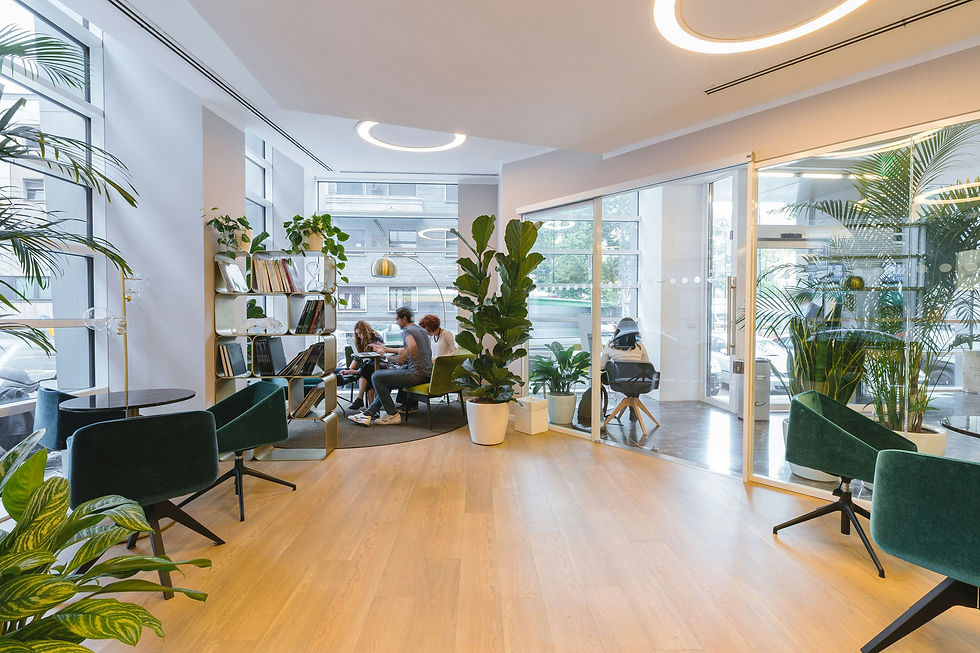
In co-working, design is a direct driver of occupancy and pricing power.
The insight Colony built its business on: most workplaces invest in the lobby and reception, then fill the actual working space with standard cubicles and fluCorescent lighting. It is the hotel that spends everything on the lobby and nothing on the rooms.
Invest in where people actually spend their time. The desk, the chair, the lighting at the workstation — these are what members experience for eight hours a day.
The aesthetic goal is "coming home," not "five-star hotel." Contrasting elements — old and new, formal and warm — create spaces that feel alive rather than staged.
Non-negotiables: high ceilings, natural light, dedicated fibre internet (not a standard business broadband plan), ergonomic furniture, sufficient meeting rooms, good temperature control.

Step 6: Price it properly
Do not race to fill seats by pricing low. Underpricing trains your market to expect low prices, makes future increases painful, and signals that your space is not worth paying for.
Price to reflect the experience you are actually delivering.
On metrics: occupancy rate alone is meaningless. A space that is 90% full at rates too low to cover costs is a slow failure that looks good on a slide deck. What actually matters is cash from operations — how much cash the business generates after all expenses.
Step 7: Hire right and build culture
Your first hire should be a Community Manager — the face of your space. Hospitality experience matters more than co-working experience. You can teach someone about hot desks; you cannot teach them how to make people feel genuinely welcome.
Colony's counterintuitive bet was investing heavily in people in a business that is fundamentally capital-driven.
It worked.
When they first surveyed their team on whether they would recommend Colony as a place to work, the score was negative seven. After years of deliberate culture-building, it climbed to over sixty. The business results followed.
One instrument worth adopting early: a simple staff survey asking whether your employees would recommend working at your company. If the answer is no, your members will eventually feel that in every interaction — in how they're greeted, how problems are handled, how welcome they feel. Internal culture leaks outward.
Fix it before it reaches the member experience.
Step 8: Market your space
Start sixty to ninety days before you open. Offer a founder member rate to your first cohort — twenty to thirty percent off the first few months. People who join before you open become your most invested advocates.
Set up your Google Business Profile before launch. When someone searches "co-working space near me" or "co-working Bangsar," you want to appear with photos, hours, and reviews already in place.
Host events — open houses, free coworking days, networking sessions. Once people are inside a well-designed space, it sells itself.
Build a referral programme. Your existing members are your best salespeople. A discount or a free month makes it easy for them to bring in people they know.
Corporate sales requires a different approach entirely — relationship-driven, longer sales cycle, and a clear business case around staff retention and cost flexibility. Run it in parallel with consumer marketing, not instead of it.
Step 10: Know when to cut
No guide to opening a co-working space is complete without talking about closing one.
If a location has been running for three years and is still not profitable with no clear path forward — cut it. Write off the money you spent on the fit-out, recognise the tax loss, move on.
The mistake most operators make is waiting until they are forced to cut. Cut while you still have the financial strength to make the decision cleanly.
One structural advantage of a co-working business is that it is heavy on renovation and fit-out costs but light on headcount. Which means when you close a location, you do not necessarily have to let people go.
You cut the centre, not the team. Protect this by keeping your headcount lean and your people well-paid rather than overstaffing and facing the much harder conversation of retrenchments later.
How to open a co-working space in Malaysia: One last thing
The space, the design, the community — that is the part worth doing.
The SSM registration, business premises licence, annual returns, tax filings, bookkeeping, and corporate secretary requirements — that is the part that gets in the way before you have even opened the doors.
Douglas Loh & Associates handles the business setup and compliance groundwork so you can conentrate on the part that excites you, not the boring paperwork.



Comments